
If your home or workplace feels cluttered, you’re not alone—and effective rubbish removal is often the missing link between chaos and calm. You don’t need a full renovation or expensive storage systems to reclaim your space. With a few smart habits and simple systems, you can keep rubbish under control and make every room feel lighter, clearer, and easier to live in.
Below are seven practical rubbish removal hacks you can start using today, plus answers to common questions people ask when trying to cut clutter for good.
1. Start with a “Rubbish Audit” (Know What You’re Really Dealing With)
Before you start dragging bags to the curb, step back and figure out what’s actually piling up. A quick “rubbish audit” helps you target the real problem areas and stop clutter at the source.
Walk through your home with a notepad (or notes app) and ask:
- Which areas collect rubbish fastest? (e.g., entryway, kitchen counter, desk, bathroom)
- What types of rubbish show up repeatedly? (packaging, junk mail, takeaway containers, old toys, broken electronics)
- Which items are genuinely trash, and which could be recycled, donated, or reused?
You’ll usually see patterns:
- If packaging is the issue, you might need different shopping habits or better recycling routines.
- If paper piles are everywhere, you likely need a mail and document system.
- If broken or unused items dominate, you might have a delayed decision problem (“I’ll fix it later,” “I might use this someday”).
Once you see the patterns, rubbish removal becomes less about random cleaning sprees and more about solving specific bottlenecks.
2. Use the 4-Box Method to Tackle Any Room
Clutter feels overwhelming when everything is mixed together. The 4-box method is a simple, structured way to sort rubbish and reclaim space without getting stuck.
Grab four boxes or bags and label them:
- Keep (Here) – Items you use regularly and that belong in this room.
- Relocate – Items to keep, but that belong somewhere else.
- Donate/Sell – Usable items you don’t want or need anymore.
- Rubbish/Recycling – Broken, expired, unusable items and obvious trash.
Then:
- Work one small area at a time (a single drawer, shelf, or corner).
- Touch each item once and make a decision right away.
- Don’t start a second area until you’ve finished the first.
When the boxes are full:
- Put “Keep (Here)” items back in an orderly way.
- Move “Relocate” items to their proper rooms.
- Bag and label donations and place them by the door or in your car.
- Take rubbish and recycling out immediately.
This method prevents decision fatigue and keeps you from making one room tidy by simply shifting mess to another.
3. Create “No-Landing” Zones for Daily Rubbish
A major rubbish removal challenge isn’t the big clear-outs, but the slow drip of everyday stuff. Keys, bags, mail, packaging, school forms—they all need a designated home or they’ll colonize your benchtops and floors.
Designate a few “no-landing” zones where rubbish is not allowed to pile up:
- Kitchen counters: Only allow active cooking items, not mail, bags, or random objects.
- Dining table: Meant only for eating or specific projects, never long-term storage.
- Bedroom floor: No clothes or bags; everything must go into a hamper, wardrobe, or hook.
To support these zones, add simple, low-friction systems nearby:
- A small recycling station close to where you open packages.
- A wall-mounted mail sorter near the front door.
- Hooks and trays for keys, hats, and bags.
- A hamper or basket in every bedroom (and maybe the hallway).
The idea is to make the “right” action (putting things where they belong) easier than dumping them in a convenient pile.
4. Adopt the “One-Touch” Rule for Incoming Items
Rubbish builds up every time you delay a decision. The “one-touch” rule cuts clutter at the root: whenever possible, handle new items only once.
When something comes into your space:
- Mail and leaflets: Open, scan, and immediately recycle what you don’t need. File what matters, or take a picture and store it digitally.
- Parcels and packaging: Open near your bin or recycling station. Put the item away and dispose of packaging right then.
- Groceries and supplies: Unpack and store everything in one go; don’t leave bags on the floor “for later.”
- Receipts and paperwork: If you don’t need it for tax, returns, or records, bin or digitise it on the spot.
Delaying turns a simple quick task into a future 30-minute tidy-up. By making decisions in the moment, you naturally reduce the amount of rubbish removal you need to do later.
5. Set Up Smart, Sorted Rubbish & Recycling Stations
If tossing things properly is inconvenient, people will default to the nearest flat surface. A well-designed rubbish removal station makes it painless to keep things under control and to recycle more.
In the kitchen (or main living area), set up:
- A standard rubbish bin.
- A clearly labelled recycling bin (or multiple bins if your area sorts glass/paper/plastic).
- A small compost caddy or food-scrap container if you have garden compost or green-waste collection.
- Optional: a bag or box for soft plastics, batteries, and e-waste if your area has collection points.
Place these where you actually create rubbish: near the food prep area, where kids do crafts/homework, and near the entry where you open parcels.
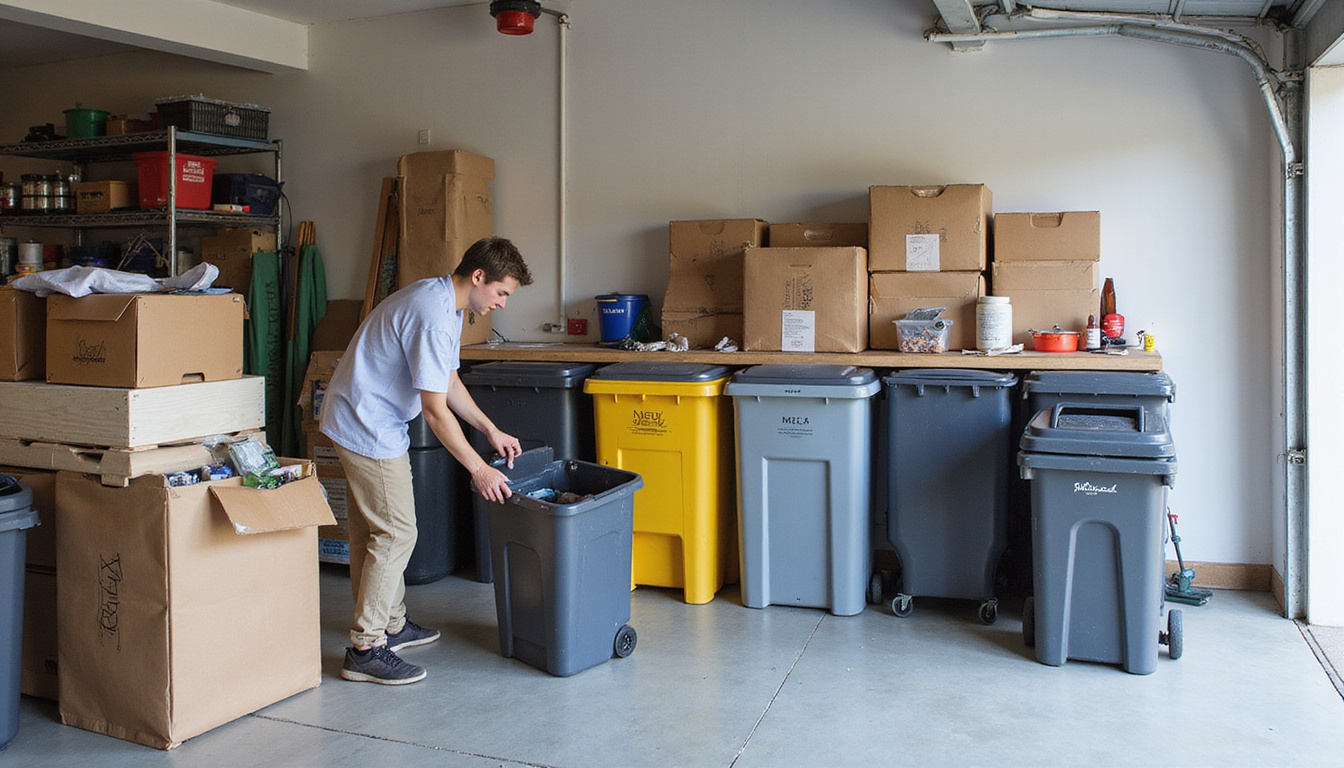
Check your local council or government site for what’s accepted in your area—many people underestimate how much they can recycle (source: UK Government – Recycling collections).
To keep things neat:
- Choose bins with lids if smells or visuals bother you.
- Use stackable or under-sink bins in small spaces.
- Label clearly so guests and kids know what goes where.
6. Turn Rubbish Removal into a Weekly Micro-Habit
Big clear-outs are exhausting. Instead of waiting until your space feels unbearable, build rubbish removal into your regular routine as a short, non-negotiable habit.
Try one or more of these:
- The 10-minute Sunday sweep: Set a timer for 10–15 minutes once a week. Focus only on grabbing obvious rubbish, recycling, and donation items from high-traffic areas.
- Daily “reset” ritual: Spend 5 minutes every evening putting rubbish in bins, returning items to rooms, and clearing surfaces in the kitchen or living room.
- “One area per day” rule: Monday = dining table, Tuesday = bathroom surfaces, Wednesday = entryway, etc. You’ll cycle through the whole home without a big time investment.
You can even gamify it:
- Challenge household members to each find 5 things to throw away or recycle every day.
- Track full rubbish and recycling bags filled each week and aim for a consistent number.
When rubbish removal is routine, clutter never has time to take over.
7. Know When to Call in Professional Rubbish Removal Services
Sometimes the volume or type of clutter is beyond a quick DIY effort. In those situations, professional rubbish removal services can save time, stress, and even money in the long run.
Consider calling in help when:
- You have large, bulky items: mattresses, old furniture, broken appliances, renovation debris.
- You’re moving house, downsizing, or clearing out an estate.
- There’s safety risk: mould, sharp objects, hoarding situations, or unknown substances.
- Your local council collections are infrequent, limited, or don’t accept what you need to dump.
Professional rubbish removal companies typically:
- Provide labour to carry items out (downstairs, through narrow halls, etc.).
- Sort what can be recycled or donated versus actual waste.
- Have access to facilities for e-waste, green waste, construction materials, and more.
Before you book, ask:
- What materials they accept.
- Whether they donate or recycle usable items.
- How pricing works (by volume, item, weight, or time).
- Whether they’re licensed and insured in your area.
Bringing in professionals is not a failure; it’s a smart strategy when the job is bigger than your time, tools, or energy.
Simple Checklist: Rubbish Removal Habits to Reclaim Your Space
Use this quick list as a reference:
- [ ] Do a quick “rubbish audit” of your main clutter zones.
- [ ] Try the 4-box method in one room or area.
- [ ] Define 1–3 “no-landing” zones (e.g., kitchen counter, dining table).
- [ ] Set up or upgrade your rubbish and recycling stations.
- [ ] Start practicing the “one-touch” rule for mail and parcels.
- [ ] Schedule a weekly 10–15 minute rubbish sweep.
- [ ] Decide if any large or hazardous items require professional rubbish removal.
FAQ: Common Questions About Rubbish Removal and Clutter Control
1. What is the most efficient way to do rubbish removal at home?
The most efficient way to handle home rubbish removal is to combine sorting and routine:
- Use the 4-box method (keep, relocate, donate/sell, rubbish/recycle) in one area at a time.
- Put rubbish and recycling stations where rubbish is created.
- Add a weekly rubbish sweep so build-up never gets out of control.
This way, you’re dealing with rubbish as part of daily life, not only in exhausting, once-a-year marathons.
2. How often should I schedule household rubbish removal and recycling?
A good baseline:
- Rubbish bin: Empty at least once a week, more often for food waste.
- Recycling: Take out weekly so containers don’t overflow.
- Donation drop-offs: Aim for once a month if you’re actively decluttering.
- Bulk rubbish removal: Once or twice a year for large items, or whenever you finish a major clear-out or renovation.
Regular, smaller efforts keep the load and the stress down.
3. When is it better to hire a rubbish removal company instead of DIY?
Hire a rubbish removal company when:
- Items are too heavy or large to safely move yourself.
- You have a full room, garage, or yard of accumulated junk.
- You’re dealing with construction, renovation, or garden waste that your council doesn’t collect.
- There are health or safety concerns, such as mould, vermin, or hoarding levels of clutter.
In those cases, professional rubbish removal can be faster, safer, and more environmentally responsible than multiple DIY trips to the tip.
Reclaiming your space doesn’t require perfection, just consistent, simple systems. Start with one room, one bin, or one weekly habit, and build from there. If you’re facing bigger items or an overwhelming volume of junk, don’t hesitate to bring in a professional rubbish removal service to reset your home in a single day.
Take the first step now: choose one area in your home, set a 15-minute timer, and use the hacks above. You’ll feel the difference the moment you clear that first bag—and it’s the start of a calmer, clearer, more liveable space.
Junk Guys Inland Empire
Phone: 909-253-0968
Website: www.junkguysie.com
Email: junkguysie@gmail.com