
When you’re planning a renovation, effective flooring removal is the first big hurdle between you and a flawless new floor. Do it wrong and you’ll battle leftover adhesive, damaged subfloors, and squeaks later. Do it right and installation becomes faster, cleaner, and far more professional-looking. This guide walks you step-by-step through how to strip and prep subfloors quickly—without sacrificing quality or safety.
Why Flooring Removal Matters More Than You Think
It’s easy to get excited about installing new hardwood, tile, or luxury vinyl and treat flooring removal as just a demolition chore. But this stage is where you:
- Protect your home from dust and damage
- Preserve or repair your subfloor
- Ensure your new floor lies flat, quiet, and secure
- Prevent future issues like cracking tile, buckling boards, or noisy planks
Professional installers will tell you: 80% of a great floor is in the prep. That prep starts with thoughtful, systematic removal.
Step 1: Assess Your Existing Floor and Subfloor
Before you touch a tool, identify what you’re working with. Different materials need different strategies and tools.
Identify the top flooring material
Look at the visible floor and any exposed edges (doorways, vents, transitions):
- Carpet – Soft, with visible seams, tack strips along the perimeter
- Carpet tile – Squares or planks, often in commercial spaces
- Sheet vinyl or linoleum – Continuous sheet with patterns; edges tucked under baseboards
- Vinyl plank or laminate – Interlocking pieces; often “floating”
- Glue-down vinyl or VCT – Thin, hard tiles or planks, firmly adhered
- Engineered or solid hardwood – Tongue-and-groove boards, nailed, stapled, or glued
- Tile (ceramic/porcelain/stone) – Grout lines, hard and brittle
Identify the subfloor
Pull up a floor vent cover, transition strip, or small hidden section to see what’s underneath:
- Plywood or OSB – Common in most homes; easier to work with
- Concrete slab – Typical for basements and some ground floors
- Old plank subfloor – In older homes, boards laid diagonally or straight over joists
Knowing what’s below helps you choose the right scraping tools, patching products, and moisture testing methods later.
Step 2: Safety First – Protect Yourself and Your Space
Flooring removal kicks up dust, debris, and sometimes hazardous materials. A few precautions save money and health.
Personal protection
At minimum, use:
- Safety glasses
- Heavy-duty work gloves
- Knee pads or a kneeling pad
- Dust mask or, better, an N95 respirator
- Hearing protection if using power tools or chippers
Watch for asbestos and lead
If your home is older than the 1980s, you may be dealing with:
- Asbestos – Common in old vinyl sheet, vinyl tile, and certain adhesives
- Lead paint – Sometimes in older trim or thresholds attached to flooring
If you suspect asbestos or are unsure, do not start scraping or sanding. Have a small sample tested by a certified lab or consult an abatement professional (EPA guidance: epa.gov/asbestos – source). The cost is far less than unsafe disturbance.
Protect the rest of your home
- Seal doorways with plastic sheeting and painter’s tape
- Remove doors (where convenient) to avoid damage
- Cover built-ins and nearby furniture
- Use a shop vac with a HEPA filter and keep it handy throughout
Step 3: Tools and Supplies for Fast, Efficient Flooring Removal
The right tools make the difference between a day’s work and a week-long battle. You don’t need everything on this list, but many can be rented inexpensively.
Basic hand tools:
- Utility knife with fresh blades
- Flat pry bar and larger “Wonder Bar” style pry bar
- Hammer and small sledge
- Floor scraper (manual)
- Pliers and nail puller
- Tape measure and straightedge
Power tools / rental tools:
- Oscillating multi-tool (for flush cuts at walls and door jambs)
- Circular saw with depth set just to flooring thickness
- Demolition hammer or rotary hammer with chisel (for tile)
- Walk-behind floor scraper (for large glued-down floors)
Prep and repair supplies:
- Floor patch/leveling compound (appropriate for wood or concrete)
- Wood filler or exterior-grade wood putty
- Construction adhesive (for subfloor reattachment)
- Deck screws or subfloor screws
- Moisture meter (for wood or concrete)
Have everything assembled before you start a room; constant trips to the hardware store are the enemy of “quick.”
Step 4: Removing Different Types of Flooring Quickly
Each flooring type has a best-practice removal approach. Use the right technique to save time and avoid damage.
Carpet and carpet pad
- Clear the room – Remove furniture, doors, and floor vents.
- Cut manageable strips – Use a utility knife to cut carpet into 3–4 ft wide strips.
- Roll and tape – Roll each strip tight and tape it for easy carrying.
- Remove the pad – Carpet pad usually tears up easily but may be stapled. Pull in sections.
- Pull tack strips carefully – Use a pry bar and hammer to lift tack strips; wear gloves – they’re sharp.
- Remove staples – Use pliers or a floor scraper to shear off or pull remaining staples.
Tip: For large areas, knee-kickers or carpet pullers can speed up the initial release from tack strips.
Floating laminate or click-together vinyl plank
These are often the fastest for flooring removal:
- Start at an exposed edge – Thresholds or transition strips are good entry points.
- Lift and separate planks – Gently lift and unlatch each plank in reverse installation order.
- Stack neatly for disposal or reuse – Many planks are reusable if not damaged by moisture.
Do not force planks; most will unlock cleanly when lifted at the right angle.
Glue-down vinyl, VCT, or resilient flooring
This is where good tools pay off:
- Score and cut – Score the surface into strips or squares with a utility knife.
- Use a floor scraper – Start at a seam or edge; push the scraper under the material.
- Heat stubborn adhesive – A heat gun softens adhesive and speeds removal in smaller areas.
- Consider a powered scraper – For large spaces, a stand-on or walk-behind scraper cuts hours off the job.
You’ll often still have adhesive residue to deal with—that’s covered in the subfloor prep section below.
Hardwood (nailed, stapled, or glued)
This is harder work, but a logical process speeds it up.
For nailed or stapled hardwood:
- Find the direction – Boards run one way; your cuts will go perpendicular.
- Set circular saw depth to flooring thickness only (not into the subfloor).
- Cut sections – Make cross-cuts every 12–18 inches.
- Pry up sections – Use a large pry bar; start in the middle of the room where boards flex more easily.
- Remove nails or staples – Pull or pound them flush with the subfloor.
For glued-down hardwood or engineered:
- Cut into smaller sections with a circular saw.
- Use heavy-duty scrapers, pry bars, and possibly a demolition hammer with a wide chisel blade.
- Expect adhesive cleanup on the subfloor afterward.
Tile flooring
Tile is slower but manageable with the right tools:
- Break the first tile – Use a hammer and chisel in a grout joint; once you have a starting point, others come easier.
- Use a demolition hammer with chisel – At a low angle, work under tiles to pop them up.
- Remove thinset mortar – Use a floor grinder, scarifier, or chisel attachment to knock down mortar ridges.
- Vacuum frequently – Tile and mortar dust is abrasive and hazardous; use a HEPA shop vac.
Always wear eye and respiratory protection; tile shards are sharp.
Step 5: Fast, Smart Subfloor Prep for New Flooring
With the old surface gone, quick but thorough prep is key. This is where you ensure your new floor won’t squeak, rock, or crack.
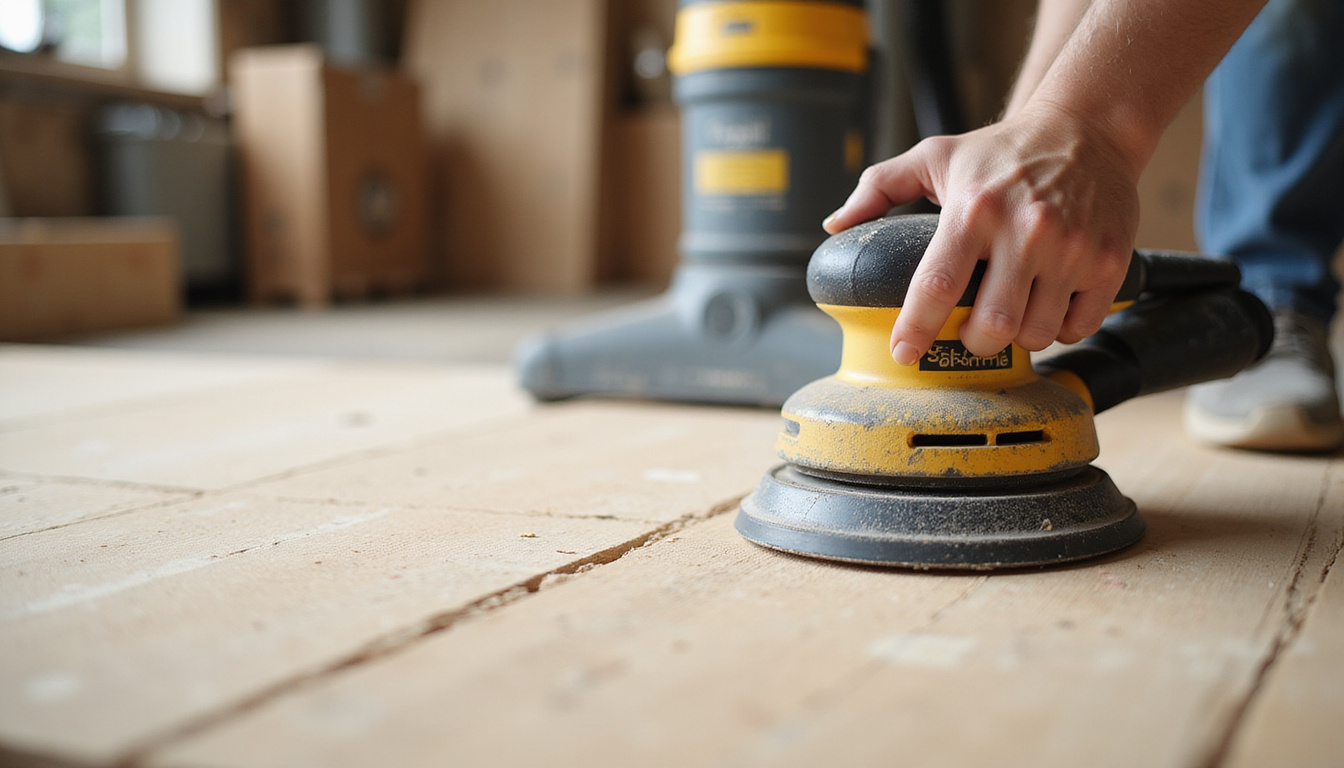
1. Clean the subfloor
- Sweep and vacuum thoroughly
- Remove all loose debris, nails, staples, and drywall mud blobs
- Scrape off high spots of old adhesive, paint, or thinset
You want a clean surface so issues are visible and patching products adhere well.
2. Check for damage and movement
Walk the floor slowly:
- Listen and feel for squeaks or springy spots
- Look for water damage, rot, or dark staining
- Identify cracks (in concrete) or gaps (in wood)
Mark problem areas with painter’s tape or pencil.
Fixing wood subfloor issues
- Squeaks or movement:
- Add screws through the subfloor into joists where the movement occurs
- Use deck or subfloor screws, not nails, for long-term hold
- Delamination or rot:
- Cut out damaged sections with a circular saw
- Patch with new plywood/OSB of matching thickness, screwed to joists
- Gaps and minor surface damage:
- Fill small voids with appropriate wood filler or floor patch (as specified by your flooring manufacturer)
Fixing concrete subfloor issues
- Cracks:
- Hairline cracks can often be left or filled with appropriate crack filler
- Wider cracks may need structural evaluation and epoxy or polymer repair systems
- Holes and spalls:
- Use a concrete patching compound; follow curing times
3. Deal with old adhesive and residue
For wood subfloors:
- Light, well-bonded residue can sometimes stay if compatible with new adhesive (check manufacturer instructions)
- Heavy, uneven glue must be scraped or lightly sanded
- Avoid deep grinding that thins or damages the subfloor
For concrete slabs:
- Mechanically remove thick adhesive with a floor grinder or scraper
- Avoid strong chemical strippers unless manufacturer-approved; residue may interfere with new adhesives
- Ensure no loose or gummy areas remain
4. Flatten the subfloor (not just “level”)
Most modern flooring—especially large-format tile and rigid core vinyl—requires a very flat subfloor.
- Use a long straightedge (6–10 ft) or a long level
- Check in multiple directions
- Mark low and high spots
Then:
- Grind down high spots (for concrete) or plane/sand wood humps
- Fill low spots with floor leveling compound (self-leveling underlayment or skim coat) following mix and cure instructions
Manufacturers often specify a maximum variation (e.g., 3/16" in 10 ft); meeting these specs is critical for warranty and performance.
5. Check moisture before installing new flooring
Moisture can destroy new floors, particularly wood and some vinyl products.
For wood subfloors:
- Use a pin-type moisture meter to verify acceptable levels per your flooring manufacturer (often 6–12%)
For concrete slabs:
- Use a moisture meter, RH test kit, or calcium chloride test as recommended
- If levels are high, consider moisture mitigation systems or alternate flooring types
Only proceed with installation when moisture is within the safe range for your chosen floor.
Quick Checklist: Flooring Removal and Subfloor Prep
Use this as a rapid reference while you work:
- Identify existing flooring and subfloor type
- Gather appropriate tools, safety gear, and patching materials
- Protect adjacent rooms and surfaces
- Remove flooring systematically by type (carpet, laminate, hardwood, tile, etc.)
- Clean and vacuum subfloor thoroughly
- Fix squeaks, soft spots, and damaged areas
- Remove or flatten old adhesive, mortar, and high spots
- Fill low spots with appropriate floor patch/leveler
- Verify flatness and moisture levels
- Confirm compatibility with your new flooring system
FAQs About Flooring Removal and Subfloor Preparation
Q1: How much does professional flooring removal cost compared to DIY?
Professional flooring removal typically ranges from $1 to $4 per square foot depending on material (tile and glued hardwood at the high end, carpet at the low end). Doing your own flooring removal can save a significant portion of that, but factor in tool rental and disposal fees, as well as your time and physical effort.
Q2: What’s the fastest way to remove glued-down flooring without damaging the subfloor?
The fastest method is usually a mechanical floor scraper (walk-behind or ride-on) combined with strategic scoring and, in small areas, targeted heat to soften adhesive. Keep the blade as flat as possible to avoid gouging the subfloor, and finish with a hand scraper to smooth any remaining ridges.
Q3: Can I install new flooring right over old adhesive after flooring removal?
Sometimes, but not always. Many manufacturers allow installation over well-bonded, thin, hard adhesive residue, especially on concrete, as long as the surface is flat and clean. Thick, uneven, or soft adhesive must be removed. Always check your specific flooring and adhesive manufacturer’s guidelines; ignoring them can void warranties and cause premature failure.
Ready to Start Your Flooring Removal Project?
A smooth, long-lasting floor starts with what you don’t see: a clean, flat, solid subfloor. By approaching flooring removal methodically—using the right tools, respecting safety, and investing a little extra time in prep—you set yourself up for a professional-grade installation, whether you’re laying premium hardwood, sleek tile, or durable vinyl.
If you’re planning a project, map out your rooms, gather your tools, and start with one space this weekend. And if you’d rather skip the heavy lifting, reach out to a reputable local flooring pro and use this guide to ask smart questions about their removal and subfloor prep process. Your future floors—and your feet—will thank you every time you walk across them.
Junk Guys Inland Empire
Phone: 909-253-0968
Website: www.junkguysie.com
Email: junkguysie@gmail.com